


Feature Image: Les Nelson, David Bondurant, Dr. Ray Artz
IEEE Life Members, David Bondurant & Les Nelson, along with Dr. Ray Artz, had a reunion in Excelsior, MN in July 2025 after 50 years. All were former Sperry Univac Defense System engineers in the 1970s, and Nelson & Artz continued working on Signal Processing applications into the 1980s and 1990s as Univac became Unisys and Paramax. There was much to talk about.
David Bondurant had been the Project Engineer on a Sensor Processor Element (SPE) internal R&D project in about 1976. This project developed a microprogrammed Single Instruction Multiple Data (SIMD) sonar & radar processor with a potential 16-processors in parallel executing complex FFT, digital filter, and other signal processing algorithms. Les Nelson joined the team to write the complex microprograms for the signal processing functions.
In about 1982, Sperry Corporation (Long Island, NY) was bidding on a new Next Generation Weather Radar (NEXRAD) System from a Joint System Program Office, made up of the NOAA National Weather Service, the FAA, US Air Force Air Weather Service, and the Naval Oceanography Command. NEXRAD’s goal was to enhance weather detection capability to issue warnings and advisory services to air, land, and maritime users.
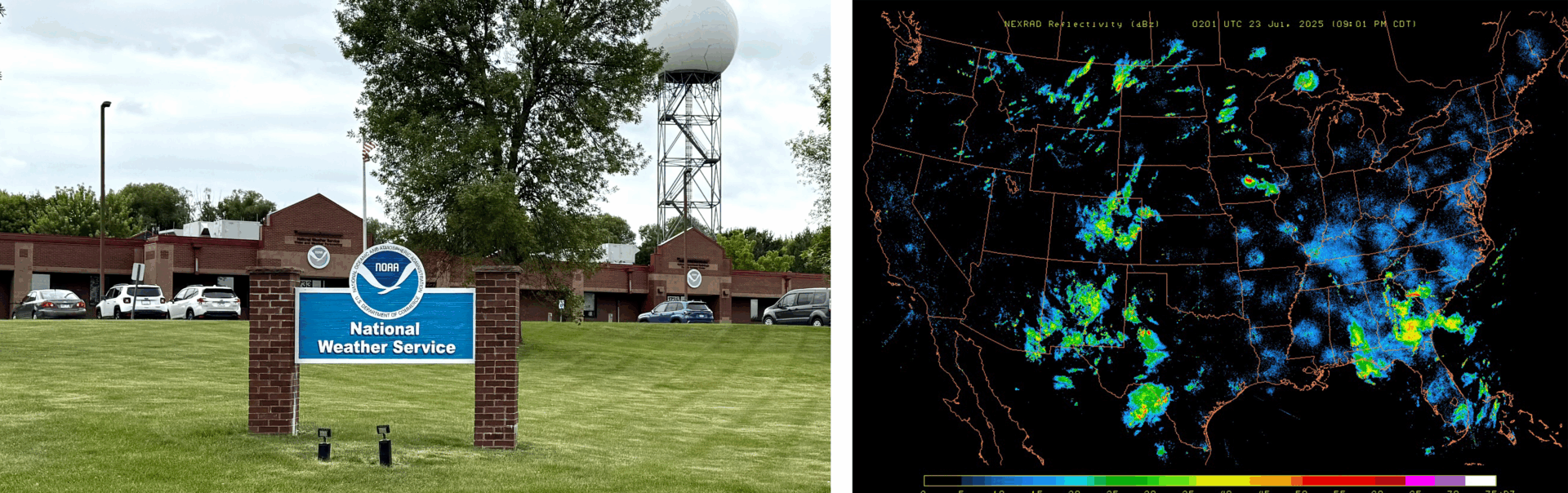
NEXRAD Radar Site; Composite Doppler Radar Map of the U.S.
As part of the program, Sperry needed a parallel programmable signal processor (PSP) with three processors to perform high-speed radar calculations in real-time. Sperry came to Univac based on their prior experience in radar processor work. Dr. Ray Artz became co-project engineer on the PSP software, and Les Nelson became a Senior System Engineer developing the microprogram to implement the radar processing algorithms. The PSP team developed a modified SPE with higher precision and improved performance. By 1988, the first prototypes were demonstrated in the field. By 1993, NEXRAD began deployment of 160 S-band Doppler weather radars throughout the country. The system continues operation today, although the PSP has been replaced by Commercial Off-the-Shelf (COTS) Processors.